 Add to Chrome
 Add to Firefox
 Add to Edge
Nuclear Segmentation
Papers and Code
Disco: Densely-overlapping Cell Instance Segmentation via Adjacency-aware Collaborative Coloring
Feb 05, 2026
Accurate cell instance segmentation is foundational for digital pathology analysis. Existing methods based on contour detection and distance mapping still face significant challenges in processing complex and dense cellular regions. Graph coloring-based methods provide a new paradigm for this task, yet the effectiveness of this paradigm in real-world scenarios with dense overlaps and complex topologies has not been verified. Addressing this issue, we release a large-scale dataset GBC-FS 2025, which contains highly complex and dense sub-cellular nuclear arrangements. We conduct the first systematic analysis of the chromatic properties of cell adjacency graphs across four diverse datasets and reveal an important discovery: most real-world cell graphs are non-bipartite, with a high prevalence of odd-length cycles (predominantly triangles). This makes simple 2-coloring theory insufficient for handling complex tissues, while higher-chromaticity models would cause representational redundancy and optimization difficulties. Building on this observation of complex real-world contexts, we propose Disco (Densely-overlapping Cell Instance Segmentation via Adjacency-aware COllaborative Coloring), an adjacency-aware framework based on the "divide and conquer" principle. It uniquely combines a data-driven topological labeling strategy with a constrained deep learning system to resolve complex adjacency conflicts. First, "Explicit Marking" strategy transforms the topological challenge into a learnable classification task by recursively decomposing the cell graph and isolating a "conflict set." Second, "Implicit Disambiguation" mechanism resolves ambiguities in conflict regions by enforcing feature dissimilarity between different instances, enabling the model to learn separable feature representations.

A Semantically Enhanced Generative Foundation Model Improves Pathological Image Synthesis
Dec 16, 2025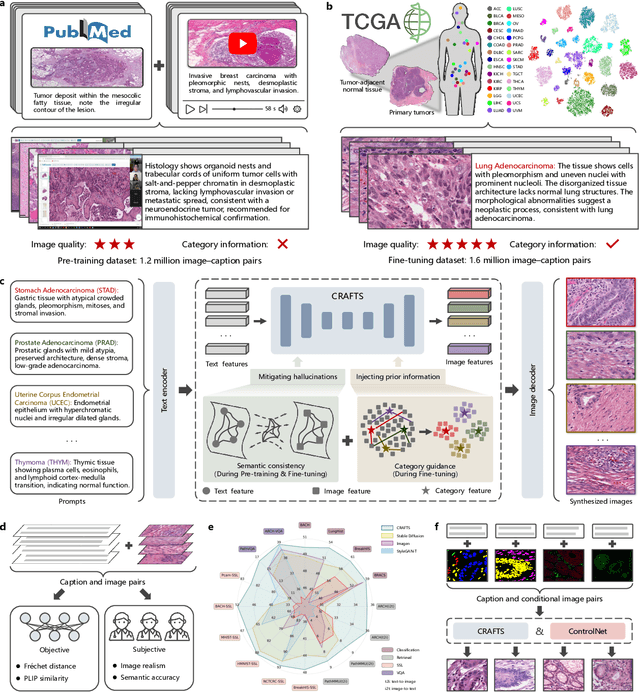
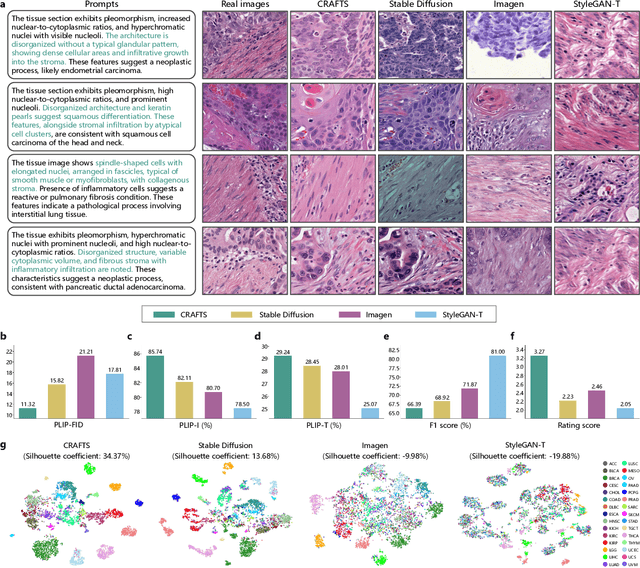
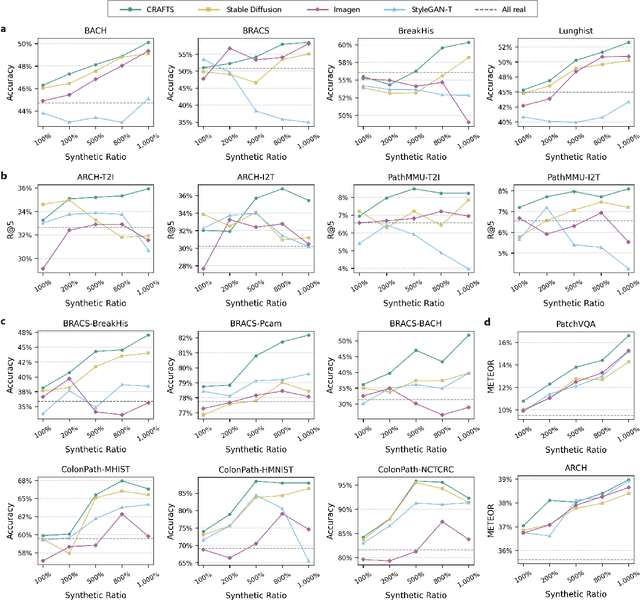
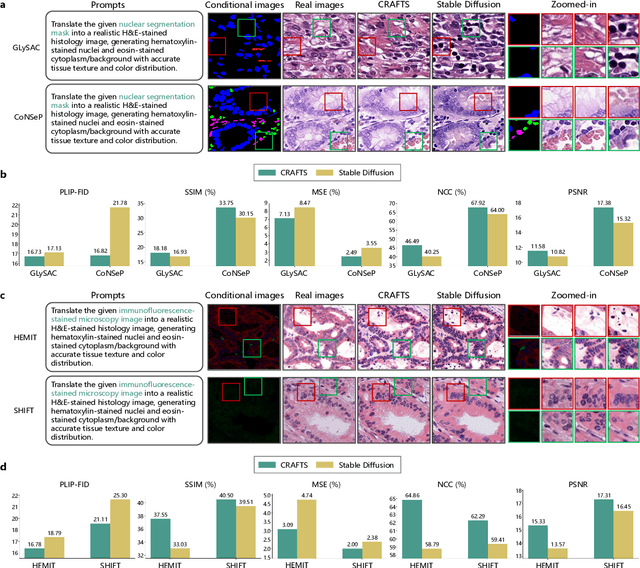
The development of clinical-grade artificial intelligence in pathology is limited by the scarcity of diverse, high-quality annotated datasets. Generative models offer a potential solution but suffer from semantic instability and morphological hallucinations that compromise diagnostic reliability. To address this challenge, we introduce a Correlation-Regulated Alignment Framework for Tissue Synthesis (CRAFTS), the first generative foundation model for pathology-specific text-to-image synthesis. By leveraging a dual-stage training strategy on approximately 2.8 million image-caption pairs, CRAFTS incorporates a novel alignment mechanism that suppresses semantic drift to ensure biological accuracy. This model generates diverse pathological images spanning 30 cancer types, with quality rigorously validated by objective metrics and pathologist evaluations. Furthermore, CRAFTS-augmented datasets enhance the performance across various clinical tasks, including classification, cross-modal retrieval, self-supervised learning, and visual question answering. In addition, coupling CRAFTS with ControlNet enables precise control over tissue architecture from inputs such as nuclear segmentation masks and fluorescence images. By overcoming the critical barriers of data scarcity and privacy concerns, CRAFTS provides a limitless source of diverse, annotated histology data, effectively unlocking the creation of robust diagnostic tools for rare and complex cancer phenotypes.
Autonomous Pressure Control in MuVacAS via Deep Reinforcement Learning and Deep Learning Surrogate Models
Dec 17, 2025The development of nuclear fusion requires materials that can withstand extreme conditions. The IFMIF-DONES facility, a high-power particle accelerator, is being designed to qualify these materials. A critical testbed for its development is the MuVacAS prototype, which replicates the final segment of the accelerator beamline. Precise regulation of argon gas pressure within its ultra-high vacuum chamber is vital for this task. This work presents a fully data-driven approach for autonomous pressure control. A Deep Learning Surrogate Model, trained on real operational data, emulates the dynamics of the argon injection system. This high-fidelity digital twin then serves as a fast-simulation environment to train a Deep Reinforcement Learning agent. The results demonstrate that the agent successfully learns a control policy that maintains gas pressure within strict operational limits despite dynamic disturbances. This approach marks a significant step toward the intelligent, autonomous control systems required for the demanding next-generation particle accelerator facilities.
CellGenNet: A Knowledge-Distilled Framework for Robust Cell Segmentation in Cancer Tissues
Nov 19, 2025Accurate nuclei segmentation in microscopy whole slide images (WSIs) remains challenging due to variability in staining, imaging conditions, and tissue morphology. We propose CellGenNet, a knowledge distillation framework for robust cross-tissue cell segmentation under limited supervision. CellGenNet adopts a student-teacher architecture, where a capacity teacher is trained on sparse annotations and generates soft pseudo-labels for unlabeled regions. The student is optimized using a joint objective that integrates ground-truth labels, teacher-derived probabilistic targets, and a hybrid loss function combining binary cross-entropy and Tversky loss, enabling asymmetric penalties to mitigate class imbalance and better preserve minority nuclear structures. Consistency regularization and layerwise dropout further stabilize feature representations and promote reliable feature transfer. Experiments across diverse cancer tissue WSIs show that CellGenNet improves segmentation accuracy and generalization over supervised and semi-supervised baselines, supporting scalable and reproducible histopathology analysis.
The Impact of Prosodic Segmentation on Speech Synthesis of Spontaneous Speech
Nov 06, 2025Spontaneous speech presents several challenges for speech synthesis, particularly in capturing the natural flow of conversation, including turn-taking, pauses, and disfluencies. Although speech synthesis systems have made significant progress in generating natural and intelligible speech, primarily through architectures that implicitly model prosodic features such as pitch, intensity, and duration, the construction of datasets with explicit prosodic segmentation and their impact on spontaneous speech synthesis remains largely unexplored. This paper evaluates the effects of manual and automatic prosodic segmentation annotations in Brazilian Portuguese on the quality of speech synthesized by a non-autoregressive model, FastSpeech 2. Experimental results show that training with prosodic segmentation produced slightly more intelligible and acoustically natural speech. While automatic segmentation tends to create more regular segments, manual prosodic segmentation introduces greater variability, which contributes to more natural prosody. Analysis of neutral declarative utterances showed that both training approaches reproduced the expected nuclear accent pattern, but the prosodic model aligned more closely with natural pre-nuclear contours. To support reproducibility and future research, all datasets, source codes, and trained models are publicly available under the CC BY-NC-ND 4.0 license.
Unpaired Image-to-Image Translation for Segmentation and Signal Unmixing
May 27, 2025This work introduces Ui2i, a novel model for unpaired image-to-image translation, trained on content-wise unpaired datasets to enable style transfer across domains while preserving content. Building on CycleGAN, Ui2i incorporates key modifications to better disentangle content and style features, and preserve content integrity. Specifically, Ui2i employs U-Net-based generators with skip connections to propagate localized shallow features deep into the generator. Ui2i removes feature-based normalization layers from all modules and replaces them with approximate bidirectional spectral normalization -- a parameter-based alternative that enhances training stability. To further support content preservation, channel and spatial attention mechanisms are integrated into the generators. Training is facilitated through image scale augmentation. Evaluation on two biomedical tasks -- domain adaptation for nuclear segmentation in immunohistochemistry (IHC) images and unmixing of biological structures superimposed in single-channel immunofluorescence (IF) images -- demonstrates Ui2i's ability to preserve content fidelity in settings that demand more accurate structural preservation than typical translation tasks. To the best of our knowledge, Ui2i is the first approach capable of separating superimposed signals in IF images using real, unpaired training data.
APSeg: Auto-Prompt Model with Acquired and Injected Knowledge for Nuclear Instance Segmentation and Classification
Apr 03, 2025
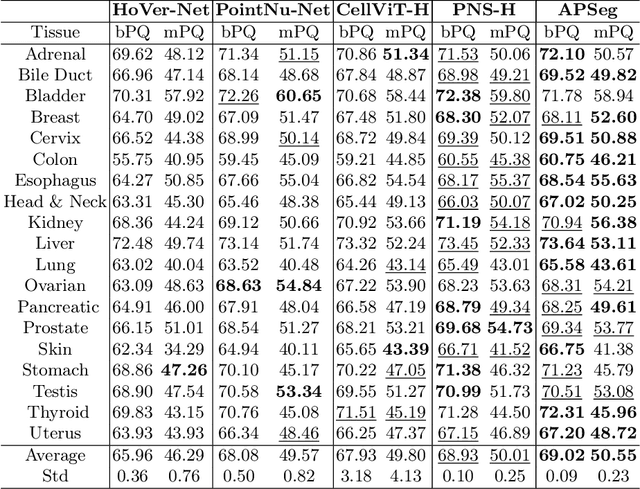
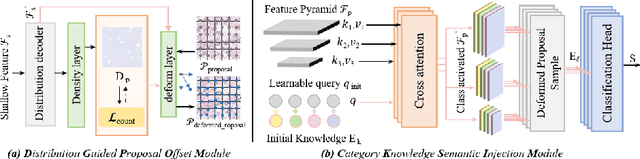
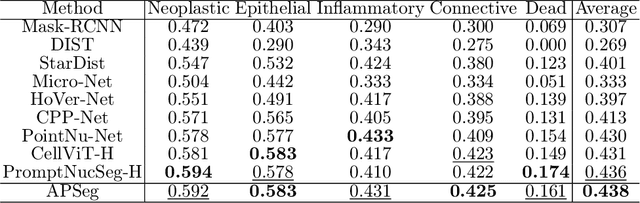
Nuclear instance segmentation and classification provide critical quantitative foundations for digital pathology diagnosis. With the advent of the foundational Segment Anything Model (SAM), the accuracy and efficiency of nuclear segmentation have improved significantly. However, SAM imposes a strong reliance on precise prompts, and its class-agnostic design renders its classification results entirely dependent on the provided prompts. Therefore, we focus on generating prompts with more accurate localization and classification and propose \textbf{APSeg}, \textbf{A}uto-\textbf{P}rompt model with acquired and injected knowledge for nuclear instance \textbf{Seg}mentation and classification. APSeg incorporates two knowledge-aware modules: (1) Distribution-Guided Proposal Offset Module (\textbf{DG-POM}), which learns distribution knowledge through density map guided, and (2) Category Knowledge Semantic Injection Module (\textbf{CK-SIM}), which injects morphological knowledge derived from category descriptions. We conducted extensive experiments on the PanNuke and CoNSeP datasets, demonstrating the effectiveness of our approach. The code will be released upon acceptance.
Instance Migration Diffusion for Nuclear Instance Segmentation in Pathology
Apr 02, 2025Nuclear instance segmentation plays a vital role in disease diagnosis within digital pathology. However, limited labeled data in pathological images restricts the overall performance of nuclear instance segmentation. To tackle this challenge, we propose a novel data augmentation framework Instance Migration Diffusion Model (IM-Diffusion), IM-Diffusion designed to generate more varied pathological images by constructing diverse nuclear layouts and internuclear spatial relationships. In detail, we introduce a Nuclear Migration Module (NMM) which constructs diverse nuclear layouts by simulating the process of nuclear migration. Building on this, we further present an Internuclear-regions Inpainting Module (IIM) to generate diverse internuclear spatial relationships by structure-aware inpainting. On the basis of the above, IM-Diffusion generates more diverse pathological images with different layouts and internuclear spatial relationships, thereby facilitating downstream tasks. Evaluation on the CoNSeP and GLySAC datasets demonstrate that the images generated by IM-Diffusion effectively enhance overall instance segmentation performance. Code will be made public later.
Geometric GNNs for Charged Particle Tracking at GlueX
May 28, 2025Nuclear physics experiments are aimed at uncovering the fundamental building blocks of matter. The experiments involve high-energy collisions that produce complex events with many particle trajectories. Tracking charged particles resulting from collisions in the presence of a strong magnetic field is critical to enable the reconstruction of particle trajectories and precise determination of interactions. It is traditionally achieved through combinatorial approaches that scale worse than linearly as the number of hits grows. Since particle hit data naturally form a 3-dimensional point cloud and can be structured as graphs, Graph Neural Networks (GNNs) emerge as an intuitive and effective choice for this task. In this study, we evaluate the GNN model for track finding on the data from the GlueX experiment at Jefferson Lab. We use simulation data to train the model and test on both simulation and real GlueX measurements. We demonstrate that GNN-based track finding outperforms the currently used traditional method at GlueX in terms of segment-based efficiency at a fixed purity while providing faster inferences. We show that the GNN model can achieve significant speedup by processing multiple events in batches, which exploits the parallel computation capability of Graphical Processing Units (GPUs). Finally, we compare the GNN implementation on GPU and FPGA and describe the trade-off.
Complex System Diagnostics Using a Knowledge Graph-Informed and Large Language Model-Enhanced Framework
May 27, 2025In this paper, we present a novel diagnostic framework that integrates Knowledge Graphs (KGs) and Large Language Models (LLMs) to support system diagnostics in high-reliability systems such as nuclear power plants. Traditional diagnostic modeling struggles when systems become too complex, making functional modeling a more attractive approach. Our approach introduces a diagnostic framework grounded in the functional modeling principles of the Dynamic Master Logic (DML) model. It incorporates two coordinated LLM components, including an LLM-based workflow for automated construction of DML logic from system documentation and an LLM agent that facilitates interactive diagnostics. The generated logic is encoded into a structured KG, referred to as KG-DML, which supports hierarchical fault reasoning. Expert knowledge or operational data can also be incorporated to refine the model's precision and diagnostic depth. In the interaction phase, users submit natural language queries, which are interpreted by the LLM agent. The agent selects appropriate tools for structured reasoning, including upward and downward propagation across the KG-DML. Rather than embedding KG content into every prompt, the LLM agent distinguishes between diagnostic and interpretive tasks. For diagnostics, the agent selects and executes external tools that perform structured KG reasoning. For general queries, a Graph-based Retrieval-Augmented Generation (Graph-RAG) approach is used, retrieving relevant KG segments and embedding them into the prompt to generate natural explanations. A case study on an auxiliary feedwater system demonstrated the framework's effectiveness, with over 90% accuracy in key elements and consistent tool and argument extraction, supporting its use in safety-critical diagnostics.